Saturday, July 06, 2013
reading, coda
Aaaah so anyway after NewsBlur annoyed me, twice, I gave up and tried out The Old Reader which I was avoiding for some reason even though on reflection of everything I read about it it was pretty obvious that it was pretty much all I looking for. I just want a list that tells me which of the slight selection of things I follow has something new. It seems to be working just fine with relatively little learning curve. The end?

Wednesday, July 03, 2013
Reeding, feeding, bleeding and misleeding...
I pretty much know myself in this strange life on the wire we're all collectively hallucinating so it did not come as a surprise to me to discover today that, sure enough, I let Google Reader expire without asserting an alternative. I was hoping whoever was in charge of Reeder would punt something for the desktop application in time for the switch but this did not occur.
I don't know, this does not seem to me to be a thing which should require an application that I pay for to accomplish, but this possibly seems to be (as I read the descriptions of all these various alternatives) because I used Reader in this incredibly bone-headed, simplistic way, as just a list of updates on a fairly discrete number of blogs and websites. All the blah-blah-blah about social and subfolders and the mobile app makes me want to take a nap. I just want to know when one of less than 30 things posts and update okay? I don't want to share, promote, or recommend anything, at least not from there. I don't want you to curate any news for me or show me Around the Web.
Should I be milling around at some lower level of the RSS protocol? It seems like this is something that my browser should just do for me for free without a lot of set up and hassle. Maybe it's more complicated than I understand. I can feel myself getting seriously generation-gapped on this one, even my basic paradigm - reading inside the browser on a desktop computer -is hopelessly mired in the last decade's paradigm.
Meanwhile, looking at what I was actually following (all laid out in plain XML courtesy of Google Takeout) it boils down to:
2 of my own blogs (I think I put them on originally just to see how updating was working)
3 blogs that update regularly
3 blogs that have not been updated in a really long time
11 blogs that are infrequently and irregularly updated (some of which are no doubt on their way to joining the previous 3 in the category prior to this one)
2 apparently defunct webcomics
2 webcomics that update consistently on a fixed schedule
1 very routinely updated art and design website with a tumblr-ish output
1 artist's tumblr that updates infrequently with long pauses
1 artist's tumblr that updates far too frequently and I'm only interested in about 5% of the material
1 personal page of a moderately famous person who posts everything they blog to Google Plus anyway
and an ongoing video series that tends to update the YouTube well in advance of its own site and posts everything new on Plus anyway.
Not totally sure I have a problem to solve after all.
Tuesday, June 25, 2013
Curse the Rabbit Hole
So I'm going to be doing something (not here but over there) that leads in with a consideration of Kevin Kelly's now-internet-ancient "1,000 True Fans" trope. I went to take another look at that article to refresh my memory. Instead I fell down the rabbit hole of the undiscussed internet, again, specifically with the odd sidenote of Fundable Dot...
Well, "dot what?" is sort of the issue. I noticed that Kelly discussed using a crowdfunding site (in this 2008 article) whose core arrangement seemed nearly identical to Kickstarter - but Kickstarter wasn't founded until 2009. A current search turned up Fundable.com - a corporate start-up site that appears designed to leverage the JOBS Act (one of those phantasms like Low Power FM Radio that seems to generate huge buzz when it's a maybe and relatively vanishes when it becomes an actuality - I'm sure it is happening out there but I've never to my knowledge listened to a LPFM station and I've yet to read any stories about a true JOBS Act-enabled crowd-funded start-up.
But its irrelevant here, Fundable.com was founded in 2011. What gives?
Then I noticed Kelly actually linked to Fundable.ORG rather than .com and followed this to a very simple website of mostly church-basement scale fundraising ideas (nothing wrong with that, but nonetheless a sharp contrast to the seeming ancestor-apparent of crowdfunding's big gorilla Kickstarter that had once gotten a nod in what looks to be Kevin Kelly's most popular Technium article ever). Hints of a scandal on the front page, which eventually led me to this Metafilter article which appears to lay out the nail in the coffin (and is primarily notable for the nascent and brief-lived phenomenon of people complaining about not being able to get into the Kickstarter beta, also the comment "Is this something I'd need Google Wave to understand?" which is obviously pretty funny).
Upon my review I wouldn't call it a scandal so much as a business and PR failure. A little additional scrounging around the principal actors reveals little except that the original Fundable's non-programmer founder was quite bitter about Kickstarter, as of 2010 anyway. I can see why, in this context, but this is a story that lays out one of the cold truths: the idea is not sufficient. Coming up with an idea doesn't entitle you to anything. You can complain if you like but in a few short years you'll have been forgotten. Hey, I came up with the iPod in 1999 (I can't remotely demonstrate that this is the year I wrote that essay but it is - not that it matters) and invented crowdfunding in 2005! And it would have worked, too, if I had more than 15 people in my "crowd"! But I'm not bitter. I am filled with love.
Wednesday, June 19, 2013
Unintended consequences cause brain-hurting efforts to figure out exactly what constitutes irony
Update... the site in question is back up (on and off) which makes this less funny (if it was in fact funny in the first place); in any event I guess you can see what the ding dang hoo haw is all about for yourself now.
So, humorous legal ripostes to dumb-ass cease-and-desist notices are funny which is why when middling-sized township West Orange, NJ sicced its lawyers on some fellow for running a website that featured the-township-name-dot-info - ostensibly due to some "falsely create the impression blah blah blah" B.S. but probably actually because his website said the Township Fathers were dumb jerks or something, the website owner's pro-bono lawyer's droll retort ended up on buzzbuzz.info. Or someplace like that. Which got dugged on Digg which probably still means something though definitely not what it did in, say, August 2011.
Which I suppose has caused all and sundry to become aware that the Township Fathers of West Orange, NJ are indeed kind of dumb jerks because of UNINTENDED CONSEQUENCES. That's irony... right?
But wait! On the heels of this publicity foul-up I typed "westorange.info" into my browser to see what the all the ding dang hoo haw was about and apparently I wasn't the only one, as what I received was a 508 RESOURCE LIMIT IS REACHED, which is to say dude's cheap-ass hosting (that his lawyer held forth as one of the points of ridicule with which to lash said Township Fathers' Lawyer for behaving as if it could reasonably be mistaken for Official Township Websites) got hit like a Angry Birds Piñata by all the rubber inter-neckers like yours truly and was removed from off the line to cool off. So as a result of protecting his website from illegal threat of being taken down dude ends up getting his website taken down. 508 UNINTENDED CONSEQUENCES LIMIT IS REACHED.
P.S. so it looks like buzzbuzz.info remains (inexplicably!) up for grabs, so have at it! Surely no one would try to sue you for "falsely create the impression blah blah blah". Right?
Monday, June 03, 2013
The last dumb cell phone in America
An exaggeration, certainly, though when I ride public transport it doesn't feel like one. The only time I see phones like this any more are in the hands of elderly relatives who as a general rule don't turn them on. I'm not anti-technology but I am, as I've noted several times before, an egregiously late adopter. Indeed I resisted the mobile phone revolution for an exceptionally long time (and used to quip that I considered being inaccessible by telephone to be a feature rather than a bug of going outside), until 2005 when I found myself frequently out and about with an infant in tow and it started to feel stupid and irresponsible to not avail myself of the technology. I went for the absolute bottom tier, a barely internet connected Nokia on prepaid minutes. I used its online connectivity exactly once, to email myself a photo of my child a friend had texted me. In the midst of that transaction T-Mobile actually interjected a friendly message chiding me over the fact that my handset could not provide me with a "rich media experience". Duly noted. I probably made it about 3 years before I sent my first text. I still basically despise texting. It's battery finally started to go after 5 years, but I managed to forestall its demise by locating a alternative brand replacement (searching for batteries for the telephone was complicated by the huge number of dodgy aftermarket battery resellers, one presumes an outlet for Chinese electrotrash recyclers, who offered great prices but routinely generated unhappy reviews by individuals who insisted that they had been sold a clearly used battery as new. I thought I might get another 3 years out of it.
To make a long and uneventful story short(er) anyway last night I did something I'd somehow managed to avoid for 6 years: I left it in the pocket of a pair of pants and proceeded to wash and dry it. To its credit, nothing exploded and the only visual effect the process had on it was that it looked very clean. I even suffered hope briefly when after apprehensively plugging it in for a few minutes it actually powered up, albeit with the T-mobile launch tune sounding a bit scratchy and garbled. My contacts appeared to be intact. Half an hour later though it was displaying nothing and plugging it in further elicited only a dangerous-sounding crackling hiss from the speaker.
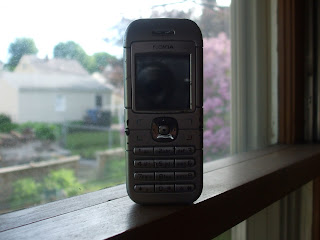 Now what? Though I, yes, despise texting and have been extremely comfortable rationing out an 8 to 12 dollar a month prepaid minute habit, I'm still wholly dependent on having the thing now and can't imagine going long without one. I left the house on an errand this morning and was well out the door when I realized I had no method of telling the time about my person. But what next? The options are absurd. I'm certainly not feeling up for a 50 - 70 dollar new monthly bill. Is there even such a thing as a prepaid smart phone? This is exactly why I have been avoiding this moment for so long. Its outcome, I'd guess, will end up as fodder for a subsequent posting.
To make a long and uneventful story short(er) anyway last night I did something I'd somehow managed to avoid for 6 years: I left it in the pocket of a pair of pants and proceeded to wash and dry it. To its credit, nothing exploded and the only visual effect the process had on it was that it looked very clean. I even suffered hope briefly when after apprehensively plugging it in for a few minutes it actually powered up, albeit with the T-mobile launch tune sounding a bit scratchy and garbled. My contacts appeared to be intact. Half an hour later though it was displaying nothing and plugging it in further elicited only a dangerous-sounding crackling hiss from the speaker.

Friday, May 03, 2013
Reeding: or, a solution which isn't really a solution, maybe? And raises all kinds of other issues.
I've been complaining about the Google Reader issue on Google Plus for a while. My method of "keeping up with things" online, for a very long time, was going through a list of bookmarks. This involved a lot of visiting sites that hadn't been updated, of course, particularly when everyone stopped blogging. Still I resisted figuring out RSS, as I resist so many innovations. Finally Google Reader was suggested to me, and since I had already stumbled, quicksand style, into the Google ecology long ago, I set it up and it has been doing the job for me for a few years.
Then The Google announced they were shutting Reader down, presumably the follow-up salvo to their instituting all sorts of unpopular changes in Reader that I hadn't noticed because I used it purely as a personal reading list, but they tell me it had a thriving community which one may deduce angered The Google because theses people weren't being social correctly, which is to say using Google Plus. Apparently this did not discourage Reader use sufficiently so the announcement of the pulling of the plug was tendered. This all seems to match Google's Cattle Chute philosophy to customer service, wherein one is chivied and unpleasantly prodded in the direction one is expected to go, and does so because one is dumb as a post and it is more difficult to go backwards than forwards, to the ultimate destination where one will presumably be electrically pacified and rendered immortal by having my brain eaten (check that biz out it's $6.99 for the ebook - that thing is like 750 pages).
In a very me fashion I dealt with this situation by ignoring it and then Google took away the Reader link from my menus in Gmail (from which location I still obstinately more or less run my digital life, making occasional and brief forays into Plus to keep up with the small segment of my compatriots that use it). This I responded to by looking up the word "reader" on the Google home page (from which I still obstinately launch almost all searches, which is pushing things beyond rebel and well into eccentric or possibly kook territory) several times a day, which was extremely stupid. Everyone suggested Feedly but I didn't like it. It stuck little Feedly icons all over everything on the internet. Feedly this, feedly that. I do not want this to be a lens through which I view the internet. I want the addition of things to be purely motivated from my end. I do not require or desire encouragement. Complaining about this resulted in a certain amount of teasing about bemoaning the features of free utilities people are giving away on the internet, and I guess things really boil down to don't use it if you don't like it. I tried a different tack, which is a Mac-based App called Reeder.
I'm deeply ambivalent about app, particularly on the desktop. I've been seriously pondering exiting the Mac ecology (and frankly if it didn't involve a ton of file conversion I'd probably be considering it even more seriously, but this computer has a good couple years in it at least anyway and who know, I may have gotten my brain eaten by then. But as things stand now installing apps (I hate that neologism too) on the iMac seems to be playing right into what I'm afraid of: the computer becoming essentially a giant gadget. Closed ecology, use it how they tell you to, pick you candy tone button from your preschool calculator array and use it primarily to Consume, Consumer!
Sometimes if I'm being honest though these objections seem specious or at least philosophical, because like a giant gadget is primarily exactly how I do use my computer. Sixty percent web browser, thirty percent super typewriter, ten percent super calculator. I have intentionally opened the terminal window on my current desktop about 3 times in 4 years.
Long story short I like Reeder, it is interacting with irregularly updated content the way I want to, as if (true to its icon) I was flipping through a plain box of files, without a lot of backtalk. Only today I finally figured out (I really am a dunce about all this business) that what Reeder is is a client for Google Reader. Which means (true to form) that it is doubtless meant to do all kinds of rad stuff with my subscriptions and I'm using it in the most unstructured, redundant manner possible (otherwise why even make a standalone client for Reader), and of course there's no guarantee it will really work post-Reader (creator says they are going to keep working on it; also says it's too soon to tell). At the least I will probably have to sign up with some other online locus of feed-read organization, so I've merely postponed my problem. But I don't have to look up Reader on Google 3 times a day anymore.
Friday, March 08, 2013
Anyone at all interested in game design should become a slacker backer of Double Fine Adventures
At least if you didn’t back the original Kickstarter...
Double Fine Adventure! was, of course, one of several over-the-top success tales on Kickstarter in 2012 - one of the million-plus elites. There’s all sorts of backstory that is supposed to go right here in this essay about the studio and its principles and their background in the classic era of point-and-click graphic adventure games. But I don’t actually know much anything about that, it’s an era of gaming I pretty much missed entirely. It’s not what got me interested in it, anyway.
There is an issue of scale and perspective in all this that is fascinating to me. The Kickstarter project started out with a goal of $400,000 which - looking at the sorts of figures Kickstarter projects, especially intellectual property projects (as opposed to vaporware gadget ones) were raising, was ambitious. It raised a (at the time, if I recall correctly, record-breaking or at least top five or something) 3.3 million which is obviously a whole hell of a lot of money to most of us - from 87 thousand backers. This is where it gets interesting to me: 87 thousand is a big number but its nothing much when it comes to video games, where top sellers’ figures start at a million. If you believe Wikipedia, Angry Birds has been downloaded a billion times, which is just stupid (and yes, I’m one of them).
The nature of creators also delights me: rather than embarking heartily upon the $400,000 scale game and rolling around cackling in the spare 2.9 million, these earnest lads and lasses immediately rescale the whole notion of the thing so that they are now attacking a 3.3 million dollar game, which is to say that they’re now grappling with something they couldn't possibly have ever gotten done by the original deadline of October 2012, and which will inevitably cost at least 4 million dollars.
This recipe for instant pathos is fantastic for me, because aside from the eventual game (I will say I retain complete faith that the game will be completed), the other primary product for the project backers is ongoing access to a documentary presentation of the production produced by 2 Player Productions, who have established a deserved reputation for their video-game centric documentaries.
The documentary has been good so far but in my estimation it really hit stride with the most recently released episode, number 8 (“Adventure Games Are Not Dead”). This is sausage factory time, really getting under the hood as the game slams into deadline and financial and personnel crunches and all the blue sky artistic and technical aspirations must be scaled and finessed to fit into the casing. Designers, artists, producers and programmers at a storied independent studio are, not surprisingly, a diverse and articulate bunch of unconventional professionals and it’s engrossing to watch them get it on as the rubber hits the road. It feels to me like 2 Player Productions is also honing their ability to really deliver the sense and feel of game design and creation in progress, walking the fine lines of not getting mired in technical minutiae, and delivering a vivid sense of the game in progress without risking too much spoilage.
Suffice to say if game design is a topic that turns your crank, I’d deem it well worth the $30 admission to become a “slacker backer” and get access to all of the game design documentaries and those to come, as well of the game, of course, by and by. It’s been an education and I remain excited whenever I see a new documentary episode has been released.
Thursday, December 27, 2012
Dream adventures on the internet
Probably this is not the first time I've had a dream where the action occurred almost exclusively on the internet, but it's the first one I remember.
I dream that I go online to look up the lyrics to the Bon Iver song "Holocene", and learn that it is actually a cover of an obscure, completely independent unsigned post-folk college band (really more of a one-man project à la The Mountain Goats) called Black Bear.
Initially the lyrics are a criticism of a season of Dr. Who, specifically a particular narrative thread about Daleks, but they go on to capture with a really artful minimalism the sort of college shared-house rental experience, and the relationships with superficially intimate acquaintances created by cohabitation with relatively random near-strangers.
The original song even has a great little video, a montage of college house and party snapshots interspersed with scenes of crude play-houses cut from blocks of crumbling foam collapsing in on themselves. I wake up at ten minutes to five, unable to get back to sleep for thinking about an unreal version of a real song by a band that never existed.
Saturday, October 27, 2012
Subversion
There’s been an article on a site called Dangerous Minds called Facebook: I want my friends back, making the rounds. Ironically (or so it seems to me, you’ll have to decide for yourself) I’m not going to link to it because it is too much an example of this “seedy underbelly” effect I was going on about the other day (see my comment on this article if you enjoy listening to me rant). You can certainly find the article yourself easily enough if you haven’t seen it already.
What that article is about is how Facebook has started intentionally throttling how much traffic people get as a result of people “liking” them or stuff they post or whatever. Normal model might be, you see a favorite musician has a Facebook page, you “like” them, their updates start showing up in your whatever the hell they call the list of crap you see when you go to Facebook. Now allegedly something like 15% of the people who “liked” you get a particular update. And what’s up with that turns out to be no secret: if you want everybody to see it you have to pay Facebook to “promote” your content.
So sure that kind of sucks and I can see how you might feel pretty ticked off if being keyed into the social media platforms was a big part of how you enticed people to go to read articles on your website so you can get paid by people who are hoping that a fraction of your visitors are dumb enough to actually believe that they have "won todays contest!" and click on an ad link.
And maybe this article had made me a bit more attentive or maybe it was just a coincidence but shortly after this article made the rounds this happened: I saw a item pop up from a Facebook friend - an individual I have a perfectly ordinary and courteous but not close relationship with. The item was that they had “liked” an individual I do not personally care for much. No need to specify further, my issue is not to call anyone out for having a right to their own opinion. The point is that this item was identified in the usual microscopic footnote as Sponsored. I did what I generally do with this sort of thing: I hid the item. Not something I care to argue about, certainly not in that venue. A day later I was on my Events list and noticed the item had showed up again in a slightly more obviously tagged-as-sponsored sidebar on that page.
What’s going on here is not subtle. The “liked” individual (or some partisan on their behalf) had paid Facebook to push items of this nature into the view of individuals related to the person who had “liked” them. This transaction occurred strictly between Facebook and whoever paid for the promotion. Facebook aggregated my relationship and my acquaintance's opinion and sold them to someone without the two of us being involved in the transaction in any way except as unintentional (and in my case unwilling) consumer and unintentional shill.
I honestly think we need to take a long and hard look at how we feel about this fundamental subversion of the nature of “word of mouth”. We are busily empowering corporations to collect unprecedented and largely invisible amounts of information about us: our social relationships, our personal conditions, our children and families. We are voluntarily telling them what we like and where we go and what we did there. Increasingly mobile devices are recording information about us automatically and if you ever agreed to the terms of service on an App without really reading it chances are you have no idea what sort of tracking and data collection you’ve agreed to.
And this is how they are going to use this data: they are going to sell it to the highest bidder and use it to manipulate how much and exactly what you see of your friends’ and acquaintances’ and relatives’ data in a manner so as to manipulate your economic and political choices. This isn’t science-fiction dystopia material any more, okay? Facebook is doing this right now.
The internet promised to democratize media. Well, I think it is time for intelligent people to wake up and take a look at what a bad bargain we’ve made of it. Orwell’s vision of Big Brother’s ubiquitous television screens is beginning to look positively quaint.
Wednesday, August 15, 2012
Penny Arcade sells short - part 4
Part 1 - Part 2 - Part 3
Update... A last minute surge pushed this project's total over $525K, simultaneously clearing the next stretch goal (removal of all ads from the front page) and dictating that my prediction failure rate for this project settles at 100%. But it's all correct in spirit! It's the most bullshit way of being correct. In other news Mike Krahulik's follow up post (written 2 hours before the fact and thus also inaccurate!) pretty clearly demonstrates that he is not exactly using my writings as a guidebook! But he is suggesting they'll come at it again next year so that pleases me. And all critique aside my general attitude after the fact is congratulations, and good luck).
With 6 hours to go on their Kickstarter project and over $35K left to meet the next goal (that would render the front page ad-free), barring the late entry of a wealthy "angel" type donor I think I finally landed on a correct prediction on Penny Arcade's foray into crowd funding in the million-plus arena.
For the Penny Arcade business, the project is only just begun. Unfortunately I think the limited success of the project is likely to have some ongoing negative impacts. This isn't anything even approaching a business-sinking gaffe for Penny Arcade, and they may well leverage it into solid gains, but they have certainly cut out a piece of work for their not-quite-half-million.
Some of the work I think will be a straight up loss. Printing and distributing the "reward" recognition certificates - I have probably sufficiently expressed the poor value I think this effort represents. I doubt there will be much value in the stunt of Mike Krahulik being filmed shouting at a duck (which will probably need the services of a pet psychologist afterwards). What are these extraneous activities really going to do except remind people of how far the project fell short of its aspirations?
The biggest if for me from the amount of work perspective is the Reality Show "Strip Search". Since a 4th season of the Penny Arcade show seemed like a given it's questionable whether people will really interpret it as a success of the Kickstarter. Beyond that it seems the concept for the show most fraught with the peril of being an absolute train wreck. Then again, I was completely skeptical of the idea of a show at all and ended up watching most of the episodes over the last 3 seasons, though I feel like it hit a peak with the first season finale that it's never quite surpassed. Also, while it may have been something to do with the filming schedule more than editorial choices, I thought it disappointing that the series to date hasn't strayed outside the "fun hijinks in a very special office" and heartwarming scenes from PAX and Child's Play arena (the whole dickwolves controversy, which was reasonably active for the better part of 6 months, receives not a whisper, for example. Never happened).
Beyond all this it is demonstrably true that "reality" selection contests do a rotten job of finding the next big anything - the potential for this show being a real turd seems high. But like I say, I've been wrong before, and Penny Arcade might just break the mold by choosing contestants based on their raw talent rather than how good of television they're likely to produce. What that does for the show is a real poser, but I might end up with another webcomic I actually want to follow.
Here's a sticky question: is it a good idea for Penny Arcade to do any of the projects that it proposed but didn't hit the funding goal for? To do so suggests that the donation requests were unnecessary and to imply that you will get whatever you get whether you support it or not. Now if they don't repeat this experiment then that won't really matter. If they do it becomes an issue. With some items (say, the Twisp and Catsby children's book) this doesn't much matter. With others (a mobile App) there's an argument that this thing is long overdue and failing to make it is kind of a sign of falling behind the state of the art in online.
Despite all this I actually hope they try it again next year. I hope the project isn't just wrapped up with a bland cheer for having gotten well beyond the goal but that its shortfall and shortcomings are acknowledged and backed with a pledge to take it to the next level next year.
I hope that in this speculative next time they set the goal as the actual goal - a million dollars for an ad-free Penny Arcade. I hope they give it the support it deserves with a decent package of exclusive rewards that have values in a decent ballpark of their actual worth. Make a project that relies on the people and tames the high-dollar inside-baseball rewards to a reasonable level. I hope they take advantage of the basic low-hanging fruit: signing stuff, for example, is the ultimate low-effort value multiplier that was totally neglected in the campaign. I hope they rethink the stretch goals and keep the core-business content goals down in the lower tiers (what you really want to attain) and hold the fan service stuff for the real stretch (encourage the superfans to kick in extra to see the service).
Mostly I hope they think about the message and hone it to a fine point. Direct funding is a great idea, an awesome idea whose time has come but the the sad reality is that many people simply will not pay. They will sit through an ad, and the advertisers will pay for the chance to practice their unholy arts in the confidence that they can profitably manipulate some portion of the most self-centered, jaded audience of non-participants. You have to talk a percentage of the crowd into paying more than their fair share. I hope the next pitch video has more and more diverse humor but that it is the spice in a solid gumbo of showing the content and pitching the principle. I hope they convince me to pitch in more than 5 bucks.
And now I've seriously gone down the rabbit hole with Penny Arcade, enough I say! Enough. Next time: something else.
Saturday, August 11, 2012
Penny Arcade sells short - part 3
Since looking askance at Penny Arcade's Kickstarter campaign shortly after its launch, I've talked about how I think they blew their pitch in their introductory video and the problems I saw in the underlying philosophy of the project from the start.
Here's the thing: I would like there to be room in Kickstarter (or the host of crowdfunding alternatives it would seem guaranteed to spawn in 3, 2, 1...) for an essentially philosophical pitch. The paradigm shift PA's Kickstarter suggested - the displacement of advertising by direct funding by the reader base - is something I'm absolutely on board with. That's why I threw them $5. And by the back of my envelope if they had convinced less than 10% of their putative 3.5 million readers to do the same they would be fully funded right now.
But if you want to execute an extraordinary idea you have to construct an extraordinary campaign. I think there were deep flaws in how Penny Arcade's campaign was constructed that prefigured it falling so thoroughly short of its highest aspirations.
My first issue was the primary goal. And I think this is the first of several arenas where the design of the campaign attempted to "customize" an observed phenomena of highly successful Kickstarter projects but got it wrong; the phenomenon in question here being the lowball price point. The obvious benefit of a low price point is it makes the goal seem less insurmountable to the potential funder, I suppose. But I think Penny Arcade's version got the narrative messed up: not to belabor this example (except I'm totally gonna because it's the one I've dwelt on the most after PA), but Double Fine's project started with a probably too-low price point and they acknowledged it was near the minimum they could turn around any sort of a game at all, let alone a full-fleshed adventure game. This is the scrappy underdog all over - we might only barely manage, but we'll deliver something that honors the spirit of what we've been talking about. By contrast Penny Arcade offered an incomplete project for it's low-ball bid. And here's the core of it: when the pitch is fundamentally philosophical (go ad free for a purer experience) an incomplete project is hardly better than no project at all. So you got rid of one ad: what's pure about that?
Right at the start of the pitch video PA business manager Robert Khoo informs the viewer what they need: a million dollars. They proceed to ask for... a quarter of that. Not because they think they can scrape by and achieve a philosophically honest version of the goal for that. At best they're offering what amounts to a token nod to the philosophy of the goal for that. So why? The unspoken but unavoidable message is that it's because the full million is too much. Too much to ask for, too much to expect. They put the idea right into the viewers mind.
I believe a huge part of pretty much every successful Kickstarter narrative is this basic idea: we can't do this without you. We can't do this unless you step up. You have to want the product, yes, but you also have to feel like you ought to help. Penny Arcade's low goal for an incomplete project spoils this story. The story it ended up with is "we're going to do our thing anyway but if you want to you can help us make a half-assed nod to doing it a better way". Is it much surprise almost 80,000 more funders were inspired by the story Double Fine spun
This leads right into my second complaint, which is the construction of the stretch goals track. Again I suspect the idea was to emulate a number of successful projects that have leveraged the enticement of stretch goals - bonus rewards or project enhancements that are triggered by reaching funding goals above the primary. I've been trying not to engage in this assessment in too much prognostication about the thinking that went into how to construct this project, since obviously I'm just guessing. But I'll justify this one by noting that site writer Jerry Holkins has discussed his fascination with the mechanics of stretch goals and runaway success in Kickstarter campaigns.
The problem here I think is that it appears to me that stretch goals in successful campaigns are something that have mostly developed organically - they are responsive to success. Penny Arcade's "treasure map" of "locked" stretch goals was an obviously prefabricated, contrived narrative. What it's actually trying to do is fix the broken pitch. Justify the actual ask. I think there is quite a bit wrong with many of the the goals themselves - too much fanservice, too little sensible connection between the putative goal (going ad-free) and the stretch "rewards" (mainly extra-comic content). In subsequent postings and updates Penny Arcade (primarily in the voice of Mike Krahulik - and it's a topic worthy of a post in itself that I'm not going to write that Krahulik has basically carried the weight of promoting this project outside of its Kickstarter page) an attempt was made to connect the narrative - the idea that freeing the creators from the work of advertising - primarily from the creativity-intensive Penny Arcade Presents projects that create original works about advertising properties - would open a space for all this new creative potential. But like so much of this project this meat was buried deep inside the increasingly convoluted narrative, and even then a lot of the connection was contrived. How is going ad-free supposed to make it more possible to create a reality "television" style show about America's Next Top Webcomic? The real story seems to be "come on, make the goal, we'll do a cool thing!"
Lastmost for this entry - and it's become clear to me that there's going to have to be a fourth one because I'm done with this for today - but much has been made of the projects rewards and they did surely suck. I pretty much said my piece about that in my initial foray. PA more or less acknowledged that they wanted to avoid committing to a lot of expenses and work in reward fulfillment. I think the goal could have been attained with a lot more generosity and style. The gag rewards were a mistake in my opinion: I just don't believe anyone's pledge hinged on getting to see Mike Krahulik yell at a duck and if not, then what you've done is make a not-insigificant amount of work to literally no benefit. The same goes for the "certificate". Could there be a stupider, more worthless reward? I'm trying not to repeat myself too much but seriously, what are you going to do with this thing? Stick it in a file or pin it to a board or throw it away. For a nominal additional cost they could have created an original, limited edition print. It needn't be top quality, it just needed to be SOMETHING. Instead they still have to negotiate a printing project and mailing out 5,000 pieces of paper that nobody wanted, nobody asked for, nobody pledged because of and most won't keep.
I think I (and many others) may have overestimated the impact of rewards on the project's limited success. But I do believe that a critical missing element was first a solid, low-tier (under $10) digital offering - a collection of wallpapers and icons, something, as long as it was new - and a solid, middle-tier tangible offering. A print, sticker, button... something tangible, produced only for the project, available only for funders, for $25 or less.
Last gripe about the rewards - too much high-dollar (over $1000), inside baseball, "patron" rewards. The result? The per-donor average is $60 to (again) Double Fine's $40. But Double Fine enticed almost 12 times as many to participate.
Last chapter I'm going to talk about how I think the partial success is actually going to be an albatross for the business for the whole next year, and how I'd do it different if I were them, which I'm not, and if they tried again, which I suspect they won't.
Friday, August 10, 2012
Penny Arcade sells short - part 2
In the previous installment I talked about the misbegotten pitch video for Penny Arcade's Kickstarter campaign. The most bizarre thing about this video was the way it spent by far the majority of its time essentially harping on how much it costs to run Penny Arcade. Intentionally or not this is what got communicated by the protracted "we hate our employees" sequence. The humor fell flat and in the end the message was hugely counterproductive: gosh, that price tag seems insanely large doesn't it?
I don't think any sufficient effort went into really figuring out what was being sold. Looking back at the pitch as summarized in the video - "no ads... a direct relationship with the reader... a return to a glorious golden age" - what is being sold is completely ideological. Again I have to go back to that question - what made the period when the comic was purely donation-funded a "golden age?" They don't have a non-ideological answer to that ("people don't like advertising almost as a general rule" is what they do come up with). On the Kickstarter page after the video a couple of screenshots are offered. These are the money shots of this whole pitch, the new world order if the plan succeeds, and I suspect this is really where the issue gets to be the perspective of inside baseball versus the perspective of the average viewer. I just sat for a couple minutes staring at those pictures, flipping between the two example images and the site as it exists now. I bet to the people who construct this site, who pore over it day after day as the primary offering and money-generator of the whole business, the differences are huge. They aren't to me. They are barely noticeable.
Notice how the primary goal (the one that actually triggers "success" of the project) is described: "Leaderboard on the homepage removed". The use of an industry term (leaderboard) that isn't in particularly common coinage is telling. Again, from the inside this is no doubt a huge change - writing off what is certainly one of the single most valuable pieces of real estate on the website. But to regular people "remove the leaderboard ad" doesn't mean anything, really, and visually it looks 95% the same. $250K for one little incremental change? Another $275K for a second little incremental change? The fact is I am naturally sympathetic to this pitch - I like the product, I respect the people who make it, and I believe in the ideology behind it. Even so at this point my eyes are starting to roll at this. You've got a successful business and it's clear you've both done pretty well by it. Now I'm supposed to dig into my spavined wallet so that you can make your front page more "pure?"
(I suspect there may be a bit of backlash to come from people who didn't bother to read the FAQs as well, namely the full explanation of the primary goal:
The leaderboard is the long, flat ad at the top of the page. Reaching $250k removes the leaderboard on the homepage. $525k gets rid of both ads on the homepage. Reaching $999,999 gets the ads removed on the rest of the PA pages, including the comic page.
It wasn't totally clear to me until I read it that only hitting the million dollar goal would actually get ads off the comic page - what some might reasonably consider the actual payload of a daily visit to the site. I wonder how clear it is to the general supporter).
I think it's likely that the lion's share of the failure of the project is there in a nutshell: an overly ideological justification for a goal that just doesn't make much of a real impact. They're frankly lucky they scraped half a million out of general goodwill and deep-pocketed patrons with a yen to play foosball in Seattle or whatever the hell.
I should add a couple of acknowledgments to this assessment. The first is that an acknowledged irony with people's indifference to the removal of PA's front page ads is that they've done an exceptionally good job with advertising. The look of the ads they display are almost always really well integrated visually with the site, and their principal of not taking ads for games they don't support and not pulling any editorial punches for advertisers is justly renowned. I appreciate this as an obstacle but its one they should have had a plan to overcome in advance. Like many aspects of this Kickstarter it feels to me like it was rushed and that they would have done well to have done some preliminary work previewing and presenting it and getting feedback to hone it before launch.
The second issues is that my summary - an ideological pitch for an unimpressive change - is pretty unfair as it ignores a lot of other justifications and incentives offered for the campaign - some debuted with the project, some added as it went along. This is absolutely true - fully parsed and considered as a whole the project is a whole lot more exciting. But here is the thing - you have to scroll down five pages to get to that meat. There is literally nothing about it in the pitch video and just a sentence about it int the project description prior to the stretch goals board. This is the definition of burying the lede.
But I'm anticipating myself now. In the next installment I'll get into how I think the mechanics of how this campaign was constructed ended up amplifying the difficulties of the pitch rather than overcoming them. In the fourth and final chapter I'll think about some negative consequences I think carrying the partly-successful project through will incur. Finally I'll talk about how I think they could actually make this pitch work if there's a next time - I'm sure Robert Khoo will be on the edge of his seat waiting for me to drop the wisdom.
Thursday, August 09, 2012
Penny Arcade sells short - part 1
So I was a little off in my predictions about Penny Arcade's Kickstarter project to replace their advertisement revenue with donations... With less than a week to go the project easily cleared its primary goal and looks on track to hit its fourth stretch goal at the $450K point.
It seems unlikely it will get as far as the $525K goal, what an honest person might call a real primary goal, the elimination of advertisement from the front page. Denigrating someone for raising a mere half million on Kickstarter might reasonably be construed as sour grapes. But I really believe there's no honest assessment that wouldn't call the project a substantial failure, with the better part of a million dollars' worth of aspirations left on the table and three quarters of the stretch goals unmet (with a full tier not even unlocked).
I've been thinking a lot about how the project stumbled. I just listened to this older Wired Game|Life Podcast (relevant discussion starts at 3135/4338) that took naysayers to task for calling Penny Arcade out for using Kickstarter when they are an established business. I don't think critics, dissenters or haters had much to do with it though: this sort of negativity can't really obstruct a project like this - in the proven capacity of negative press to drive attention it might actually help. No, the real enemy of a fundraising model like Kickstarter is not hate but indifference. Penny Arcade's Kickstarter failed to capture imagination. Most coverage of it was pretty much "well those guys are doing this thing". How did the paradigm-busting little business that could fail so thoroughly to sell this paradigm shift?
Problem #1: A truly poorly-executed initial pitch.
The introductory video to the Kickstarter is literally terrible. It is intrinsically poorly constructed and it also really showcases the fundamental weaknesses of the pitch. The first minute or so involves strip creators Jerry Holkins and Mike Krahulik ruminating about the early days when they ran the strip on donations. Holkins opines that this was the "best period" of Penny Arcade history. His only explanation for what made it best though is that it was "pure". I'll come back to that.
Suffice to say for now that what I think remarkable here is that the whole substance of the pitch is delivered at this point - no ads, run the site on donations, this will make it as it was before, which was the best time, because it was pure.
What follows is the real downfall of the video. The pair go to ask PA business mastermind Robert Khoo how much they need to raise to attain the add-free site. His answer is a million dollars. This leads into a grim, protracted schtick as the pair tear around the office ranting about the costs their employees incur by eating, owning personal mementos, etc. This goes on for 4 interminable, painfully un-funny minutes, running the joke into the ground in a manner that would make a Saturday Night Live writer proud. This is almost 2/3rds of the video's already overlong 6:46 runtime. During those four minutes literally nothing about the project is communicated. No argument is made for its value. It is literally just the one joke, a joke with scarcely any relevance to the narrative of the project (the only messaging with any value, basically that it costs a lot of money to run a business, has problems in itself that I'll get into later).
Through the entire video not one image from the comics is displayed: the pitch literally never shows you what you're supposed to be paying for. At the end it abruptly switches gears again to the ruminative Holkins and Krahulik. Holkins sums up the pitch once more: "no ads... a direct relationship with the reader... a return to a glorious golden age." "We should at least ask them if it's something they want to do," Krahulik suggests.
And here's the last funny thing about the video: they never ask. They never actually address the potential funder. Now you can say this is splitting hairs, that the ask is right there in the subsequent text but I think there is a significance to this.
Contrast this to the excellent pitch video for Double Fine Adventure. It's four minutes long, almost three minutes less than PA's. It is consistently funny with verbal and visual gags throughout - and yet it is conveying information and persuasion every minute. In the first minute there is the funny sight gag of Tim Schafer on the drums, followed by a very effective set-up, a funny but affectingly nostalgic appeal to the value of the point-and-click adventure genre, backed by concept art from games like Grim Fandango that simultaneously communicate nostalgia but also Schafer's solid cred as a game developer. The essence of the pitch is solidified by the quick schtick where a "random gamer" wants to give Schafer money for one of these games. One gamer's money isn't enough - but what if a whole bunch of gamers could do the same thing? The why of the Kickstarter thus presented is simple and direct. By midway Schafer has communicated two solid, unambiguous rewards - the game itself and a documentary that will provide a unique insight into game design. The potential funder is being invited to be involved in the development process in a real way. Other sight gags like the sequence where Schafer is irritated by an overly twitchy "point and click" interface trying to pick up his own cup reiterates what the pitch is about. It's about those great old games you're nostalgic about, warts and all.
Next I'll get into what I think is problematical about what Penny Arcade actually tried to sell with their Kickstarter; in a third chapter I'll discuss issues I saw in the mechanics of their project, and finally I'll talk about problems I see the partially successful project presenting them over the course of the year, and what might follow in years to come.
Friday, August 03, 2012
I took a quick look at the seedy underbelly of internet marketeering and now I feel icky
One of the embarrassments of modern culture is the way that the websites of mainstream news franchises are framed in the worst sort of monetizing web-vomit, full-surround adver-frames, auto-playing videos with hard-to-find mute buttons, and pop-up rollovers. Much of it the worst sort of "astronaut mom discovered this weird trick to enhance cheekbones" sort of hack snake oil. Sometimes they even advertise group-ons though thankfully that whole business seems to be on the wane.
So I was reading a stupid crime story on CBS MN Local and noticed a new low. Two columns: the left-hand column reads "we recommend" and has a list of other stories on the CBS news site. The right-hand column, headed in the same font in the same color followed by a list of links in the same font in the same color says "more from around the web". So I look more closely at this thing because the links from "around the web" look a little fishy. The only designation is a little bitty bracketed link that says [what's this]. What "this" is is Outbrain, which professes to be in the business of "helping readers discover interesting content". However what would seem to me to be the more relevant statement is "
Click here to learn how some of the foremost experts in the world recommend you position yourself for the uncertain time ahead." Wanna hear the small print? "Nothing published by Money Morning should be considered personalized investment advice." Truer words, kids. Newsmax World's article seems to be hawking a book, and though the article is dated July 7, 2012 I swear I have been stumbling over this exact think for years. Predictably the Newsmax site is heavily garlanded with a variety of advertisements brought to you by being an old white guy and general conservative hysteria. It also has Sponsored Links from, you guessed it, "Around the Web". Different "around the web" though, several degrees of class below Outbrain. Representative example: "Wife Finds Her Husbands Cure for ED." Is it... sponsored links?
Thursday, July 12, 2012
A Tale of Two Content Conflicts
It's hard out there for a pimp, and by a pimp I mean a television content aggregator.
It used to be content was about the transmission method, and infrastructure was king. Hence the "cable" company. "Dish" television. The "video" [cassette] store. The internet is all about divorcing content from a particular infrastructure. This is a good thing. It's not so good, however, for infrastructure-centric companies. And the cracks are starting to show.
A couple of recent content producer/content aggregator conflicts have made it into the news. It is instructive to observe how a couple of specific content producers have dealt with being cut off from a significant segment of their audience as a result of negotiations failing with one of their distributors.
In this corner, negotiations fell through between Viacom and DirecTV, resulting in Nickelodeon, Comedy Central, MTV, and a whole bunch of other channels going black for DirecTV subscribers. The general opinion online was that while Viacom was at least as much to blame for the failure of negotiations, customers were generally venting their ire at DirectTV on the general philosophy that they were DirectTV customers, not Viacom customers, and DirectTV was no longer providing the channels that had been included when they had signed up.
Unwilling to let this unearned bit of goodwill go unpunished, Viacom recently pushed itself into the news by cutting off online access to popular products like The Daily Show. It's a move most observers are viewing as a bid to push jonesing DirectTV customers into hassling DirectTV directly... an opinion supported by the unskippable video Viacom has pasted over the web pages for its popular shows, decrying DirectTV for dropping the shows and exhorting customers to, well, hassle them directly. It's interesting politics in the television content world but it's hard to see it generating anything other than general ill will in the customer base.
Contrast AMC's recent conflict with Dish Network. AMC has engaged in a bit of direct-action solicitation itself, airing a commercial during Mad Men telling viewers to protest to DirectTV over a (according to DirectTV, similarly cost-driven) drop. It has also engaged in some extracurricular activity online - announcing a special live stream of the season premier of Breaking Bad. Now I'm not claiming AMC is some sort of paragon here. I have no idea if there is merit to AMC's claims that DirectTV's actions are actually motivated by a desire to gain leverage in a semi-related lawsuit AMC initiated in 2008. AMC is a multibillion dollar valued publicly traded company, hardly a scrappy indie in the content world (though they are about a tenth the size of Viacom). And the no-opt-out disclaimer on their "sign up to learn about alternatives to Dish Network" box on that website - namely "AMC Networks may use this info or share it with TV providers to contact you about TV services or promotions in your area" - is some bullshit.
Still, the difference between shutting off content for everyone to try to drive ill will toward your opponent versus increasing access to content to generate goodwill for yourself is not a subtle one. The fight over the money in the inevitable shift towards on-demand and online is going to continue and it is going to be ugly. But I'm cautiously optimistic that content producers who err on the side of increasing rather than restricting access are going to win in the end.
Tuesday, July 10, 2012
Million Dollar Arcade
I've talked about Penny Arcade before, and Kickstarter as well.
The former has now offered a foray into the latter. And I can't help wondering if it represents a rare misstep for the broke-the-mold nerd media empire.
I'm really questioning the basic premise of the thing, which is that "People don't like advertising almost as a general rule". I don't like intrusive advertising, and I don't like my media experiences being literally interrupted by advertising. But Penny Arcade generally seemed to do it right - relevant advertising, with a well-publicized standard that they only advertised games they actually thought were worthwhile, and without any of the crummy pop-out rollover tricks or eye-mangling "full site skin" layover ads one tends to get in the video game advertising arena. It has literally never occurred to me to wish for an ad-free Penny Arcade and the feeling persisted, while watching their video, that what the whole thing was really about was the site's primary creators being the ones that thought doing their business without having to sell advertising space would be extra awesome. The economics of the whole thing are clearly generated by how much revenue ads generate and the issue to me seems to be, really, does anybody outside the business care about that? For me (and I sort of know better but it doesn't change how I feel about it any) it just feels like asking for an astonishing amount of money to get rid of a rather inconsequential component of a content experience I'm used to having for free.
The project itself is pushing all sorts of my Kickstarter pet peeve buttons. The rewards in particular are in large part profoundly lame. $15 for a "certificate". For god's sake at least make a sticker or a button or something, I'm supposed to frame this maybe? Add it to my portfolio? 25 bucks gets you an e-book. Seventy five dollars gets you digital downloads of "Tycho's Penny Arcade Singles." Setting aside the "value" of the e-book this boils down to asking for $50 for an ep by an amateur musician. The meaningful rewards start at $125 in the form of an original print (unlimited run). The things that stand out at me about the rewards is that there is a clear imperative not to step on any of the conventional merchandising lines (hence $25 electronic books of 14-year-old comics, or $1,000 for a dozen t-shirts...), and that they are fundamentally designed to minimize creating work in fulfillment. These are pretty deep restrictions.
The high tier rewards are largely of the "you get to have lunch with us" variety and fans being what fans are I suppose they will manage to sell most of them. I have my doubts about the externally handled (due to Kickstarter's $10K pledge limit) super-tier rewards. At the top of the heap $100,000 buys you a single custom "non-commercial" comic. This is just a flat-out bid for wealth patronage and I can't see it happening. Wealthy patrons expect a whole lot more ass-kissing than that. But then what do I know.
What do I know? I guess this remains to be seen. The project has already cleared nearly half its minimum goal in half a day, so maybe people aren't really about the rewards. To me the whole thing seems far too contrived, and calculated... Maybe it's sour grapes, I love the idea of Kickstarter... the lottery with a skill component... but have never conceived of a project idea that didn't seem boil down to "pay me to live in the manner to which I've become accustomed..." with some bullshit "product" nobody is asking for. Maybe I'm just envious that these guys could be famous and beloved enough to pull that one off. Clearly the rewards are not meant to be the deep point of this project. The deep point is reaching the "stretch goals", the promise of new original content on the site. Most of them are "locked" at this point, a videogame paradigm trick that basically means "we're going to do this amazingly cool shit we won't tell you about until you've promised us at least a quarter million dollars."
Penny Arcade's ascent has been characterized by blow-out successes - the ever-increasing heights of their admirable Child's Play charity, the lightning sellouts of their massive PAX conventions. I have a suspicion that this strangely thrown-together-feeling bid to crowd-finance an already-successful business might prove an exception. If I were a betting man I'd pick them to scrape the basic goal on general good will ("scraping" $250,000 of course would be a great day for many people) but fail most of the stretch goals. The real blow-out success stories on Kickstarter have uniformly been about providing a unique product that simply won't exist (or at least not in its fully realized form) without the success of the project, and offer a solid mid-cost reward tier where you get that unique product for a price at least in the appropriate ballpark for what it is. There's a reason for this. For people to show up in full force and put down real money for something that is not a bona fide charity, they expect a real return on their money. Something new, something special, something not everybody will have. Penny Arcade has been quick to repeatedly assert that if it doesn't work, nothing will change - they will go right back to business as usual. What's being offered as an alternative to this seems too ephemeral, and too conceptual, to me.
Now, who wants to pay $45,000 to take me out to lunch?
Thursday, June 07, 2012
Humble Indie Bundle V is most impressive to date
If you've already bought a Humble Indie Bundle you doubtless already know about this, but if you haven't (or the ongoing series of charity-driven game sales has fallen off your radar), it's worth checking this one out before it expires in a little over a week. EIGHT well-regarded, much-discussed premium indie games are available if you pay more than the average (which has been holding between $7 and $8 for most of the sale). The line-up would be a steal at even 3X that price.
Humble Bundle V
Humble Bundle V
Sunday, May 06, 2012
I am a terrible journalist
I felt like I should mention as soon as I discovered the fact that Jonathan Blow hired a writer to collaborate on the script of his forthcoming puzzle game The Witness - Tom Bissell to be specific: journalist, author, videogame commentor and critic, Guggenheim Fellow and Rome Prize winner. Which omission of detail in my recent writing makes me look, well, super dumb. I need to read up on Bissell more as I'm not acquainted with his writing but its a development that definitely makes me more optimistic about the writing in The Witness. So far reading about the level of difficulties in the puzzles in the game, I have a feeling this is just the start of The Witness making me feel dumb.
Wednesday, March 14, 2012
Experimental Indie Gaming’s Writing Problem
I am super looking forward to game designer Jonathan Blow’s upcoming game The Witness. Playing his surprise hit platform puzzler Braid gave me enormous respect for him as a designer and innovator in the medium. Reading that he is essentially gambling all the money gained by Braid’s success on bringing his vision for The Witness to life just increases that respect.
But to be clear, what excites me about The Witness is the prospect of learning its game play, working the puzzles and seeing how they interact towards the game’s climactic elements. What I’m not looking forward to is the game’s writing, by which I mean anything in it that you read or is read by an actor. Because experience tells me it just won’t be that good.
Here is a random sampling of the writing from somewhere around midway in Braid.
But to be fully couched within the comfort of a friend is a mode of existence with severe implications. To please you perfectly, she must understand you perfectly. Thus you cannot defy her expectations or escape her reach. Her benevolence has circumscribed you, and your life's achievements will not reach beyond the map she has drawn.
All I can get out of that is a contrived and badly overwritten comment about how expectations in a relationship can limit you, but what it means doesn’t much matter anyway. It’s sole relation to the game’s plot (such as it is) is it communicates the idea that Tim’s relationship with The Princess has Issues. At the point in the game this text occurs, reiterating this idea is completely superfluous. Indeed, everything you need to know about it for the sake of playing is communicated in the first line of formal text in the game:
Tim is off on a search to rescue the Princess. She has been snatched by a horrible and evil monster. This happened because Tim made a mistake.
This is a decent bit of writing, it is brief and direct and it plays with your sense of the usual dynamic of the barest of bones videogame plot (the bad guy took your girlfriend and you have to fight your way through to rescue her) with that little twist (and it was your fault it happened).
Two things make Braid great. The first is the wonderfully engrossing game play of solving spacial/temporal puzzles with its combination of traditional platformer skills and time-manipulation mechanics. It is absolutely this, rather than moving through the “story,” that keeps you playing Braid. And that’s fine: nobody plays a classic Mario for the story (spoiler alert: the Princess is in another castle, until she’s not).
But Braid rises above this tradition not solely through its innovative gameplay. It adds the icing of a genuinely satisfying game-narrative arc, by which I mean the whole experience of play from its fantastic, beautiful atmospheric opening scene, through the very effective temporal dynamic of the final levels, culminating in the superbly effective final boss. That last involves a narrative touch that I could easily sum up in a few simple sentences, but no need for spoiler warnings here. All I need to communicate is that this touch is surprising, simple, easy to understand, and it wraps up the game in perfect sync with its play dynamics and minimalist, referential narrative.
And then there is the text. Not to belabor it but the basic reality of the text is that it is just not great. Obfuscated, overwritten, generally delivering a tone of contrived artiness. Above all these deficiencies though is that it simply adds nothing of real substance to the narrative. Braid would play exactly the same with almost all the text removed. One pithy sentence on par with the opening line per level would manage the same effect.
When you add the fact that everything not-great about the text is present in spades in the game's dénouement level, I have to say that the writing actually detracts from the game. It sucks energy out of the great climax and renders the small, quiet puzzles of the post-ending’s interstitial world (which are conceptually a great element in and of themselves) less satisfying. The only proper reaction to these final textual elements (that isn’t motivated by frankly slavish, uncritical devotion to the game as a whole) is to go “What?” and “Huh?”
I feel like I have to stress before I go on that the writing in Braid isn’t terrible. It is merely not great (okay, probably even not good) which is a shame because the game is great. It is great game design, great art, great music... and mediocre writing.
Bad writing in videogames is practically canonical, setting you up the bomb and so forth. Bad writing in independent, experimental, innovative games is a pet peeve though because damn it, the designers of these games ought to know better.
Braid has a great game narrative because Jonathan Blow is a great game designer. Braid has great art because Jonathan Blow knew he was not a great artists so he went out and hired an artist. Braid has great music because Jonathan Blow knew he was not a great musician so he went out and searched for great music by musicians. Why doesn’t Jonathan Blow know he is not a great writer?
Why do video game designers not know that they are not writers? Do they think that game design and writing are the same thing? They don’t narrate their own product when it’s time to record the audio for the game, they hire a professional voice actor. Which is good because you have to be a professional to even marginally pull off something like this:
Just to review that text...
I’ve begun my voyage in a paper boat without a bottom; I will fly to the moon in it. I’ve been folded along a crease in time, a weakness in the sheet of life. Now, you’ve settled on the opposite side of the paper to me; I can see your traces in the ink that soaks through the fibre, the pulped vegetation. When we become waterlogged, and the cage disintegrates, we will intermingle. When this paper aeroplane leaves the cliff edge, and carves parallel vapour trails in the dark, we will come together.
This is gobbledygook, a mishmash of metaphors couched in ostentatious prose (wait is the paper a boat, or a cage, or you’re the paper and you’ve folded, and it’s an airplane? Sorry an aeroplane? And about this... fibre? The pulped vegetation? We’re talking about, like, paper again, right?). I’m sorry, and I’m not saying I could do better, but that is just what it is. The game looks beautiful. The music sounds beautiful. But the sum total of the narrative scope I get out of the paragraph (aside from feeling like I’m in for another beatin’ from the Art Stick) is that The Princess is in Another Castle.
And I'm going to go out on a limb and say the reason for this is that it was written by Dan Pinchbeck and Dan Pinchbeck is a digital artist and a game designer. Dan Pinchbeck is Dan "not to be mistaken with the writer Daniel Pinchbeck" Pinchbeck, the not writer. thechineseroom game team doesn't have any writers. It has artists. It has a composer. Nobody has the title writer. Is it that they don't believe they need one? Or that they think they already have one, but that it isn't an important enough role to put it in an actual title?
Please. Game designers. You can be so good at what you do. It is exciting. It is a new medium. It is art. But text is text, it’s not game design and it is a different kind of story than the one you tell with games. There are so many great writers out there scrapping in a terrible market. Hire writers. Hire writers and explain to them what the game means to you and the story you are trying to tell and let them play the games and figure out how to properly tell that necessary allotment of text that you read or hear as you play the game. Let them do their job, let them amplify and perfect your vision the same way artists and composers and voice actors do.
Saturday, March 10, 2012
i me a river, adventures in electronic bookulation
Since I’ve been going on about eBook reader gadgets for a while it will come as little surprise that I finally pulled the trigger on acquiring one. I ended up going a little weird on the specific gadget, however, for reasons I’ll cover later. First off though I’ll note that this is not really a device review, because I have next to no hands-on experience with any other reader, without which my take on how the thing works lacks the context to mean much. Call it impressions.
So I purchased an iriver Story HD:

Which at this point I fear you could probably safely call an “also ran” in the reader race. The reason I feel like you can say this is, interestingly, also a big reason I chose this particular device: Target, where the Story made its exclusive retail debut, has by all appearances given up on the device and put the remainder of its stock on sale for 50 dollars. My local branch of the hipper-than-Walmart department giant had plenty on hand but given that they were at last look still on Amazon for $95 and people were trying to move them on eBay between $70 and $130 I wouldn’t be surprised if what’s left dries up fairly quickly in the rush to take advantage of the price discontinuity, but who knows.
If you want to know what’s wrong with the thing, you know, look up a review. In a nutshell its design sense is a dowdy, its buttons-only interface is bare bones clunky for anything other than straightforward cover to cover reading, and its ergonomics are sub-par. What it offered on launch by way of compensation was a higher resolution display and built-in integration with Google Books. Showing up as it did in the midst of the majors adopting touch interface en masse, 3G connectivity and the undeniable fact that Google just does not have the profile as a media provider that an Amazon does (perhaps unfairly, as I’ll get into later) its chances were probably not great when it showed up at pretty much the same price as a the roughly equivalent Kindle or Nook. For 50 bucks, though, I thought it was worth the experiment.
I liked it as soon as I got it out of the box, but soon surmised that a lot of this was over reasons that aren't, maybe, very sensible... but are a lot like me. What I realized (on the heels of this essay) was that for once my late adopter ways had left me disappointed: I had left the electronic book go until well after the whole market was fully domesticated, and consequently not as magical and exciting. I suspect part of my hidden motivation in going off the path in this first selection was to get (or at least simulate) an experience slightly more out of the mainstream. As such its design issues are almost a plus to me - its terminally unsexy melamine-brown hospital tray back shell, it’s goofy little coffee-toned plastic chicle keypad contrasted with its up-level display and nerd-cool Google connection. I took undue pleasure in trawling the internet, over several days, for more winsome editions of free public domain literature, defying the lords of Amazon and their Whispernet as I loaded it all up on a gigabyte SD card I had sitting around, plugged into a little USB reader dongle that I also had sitting around. Bought a couple odd ball à la carte downloads for this library as well - including that Rucker short story collection I mentioned the other day (such a steal, now available in a straight .epub direct from the source). Finally to fingernail open the little door in the back of the reader to slot it, boot and just like that, a respectable library of 200+, and I got my magical moment with technology new to me, however swiftly it might be getting overshadowed in the march of the tablet paradigm.
Of course how I’m actually spending 95% of my time with the thing is reading Neal Stephenson’s Reamde that I bought from Google for the same $14.99 the Kindle or Nook edition would run me.
The primary risk of all this is that I’m steadily locking myself into an .epub file preference which is currently incompatible with Kindle. All I can say about that is, you know, get with it, Amazon. Everybody supports .epub except you. EVERYBODY.
A few negatives and a positive to wrap this up. I am not so convinced of the general superiority of the Apple Design Revolution but but really the ergonomics on this thing are a little off. Turning a page involves your thumb going either to the middle of the lower fifth or the bottom right corner, both of which just aren’t quite right. Of course it still beats wrestling with one of Stephenson’s 3.5 lb. doorstops, not to mention the vastly superior ergonomics compared to holding a conventional 200 volume library in one hand.
Still. Given that signing into your Google account can be a frequent necessity of trying to use it as anything other than read-only storage, given further that a solid 20% of the front architecture is given to the keypad, it’s hard to excuse said keypad’s lack of a numeric row and a few judicious symbol keys (. and @ and @gmail.com) - these offered instead as clumsily mapped alpha keypad alternatives visible only on a display-based “symbol” menu. Repeatedly entering my relatively strong password rapidly became infuriating.
That “repeatedly” brings in the second negative, though there is a distinct possibility that this one, or at least a large part of it, was on me. You access Google Books through your google account and actual content of these books live in Google’s cloud until you download them. If you pick stuff up via your computer they won’t show up on the reader at all until you refresh your library. Yesterday all my library refresh processes started to hang. The device didn’t crash - I could pull out of the hung update with the home button - but otherwise it would not resolve: left to itself, the reader would ultimately go into its sleep mode from which it would wake back at the home screen, library unrefreshed. I probably entered my gmail address and password 7 times fooling around trying to resolve this and experienced moments of hearty hatred for the thing in the process.
As I say this might be on me: I’d been fooling around under the hood in ways not obviously verboten but possibly (in retrospect) unjudicious: in the process of reading the box out of desperation with the glitch I discovered that it doesn’t actually support Mac OS (fucking seriously, iriver?). So the fact that I’d previously plugged it in via its mini-USB connection and been manually fooling around with files inside the drive menus that came up on my iMac might well have been what glitched it.
If not it could end up being an actually deal-breaking problem. I ended up taking it through the set-up wizard again, which wiped my settings, bookmarks, and everything in my download library, (though the latter didn’t matter because there wasn't all that much of it, and it is all in Google’s cloud). So early into owning the thing it didn’t matter much, everything was refreshed and downloaded within half an hour. If it were to become a regular occurrence however it would basically render the device unusable. Time will tell.
The only other bad thing to say is purely speculative: I’ve read enough reports about screen fragility to be concerned about it, though its clearly a far from universal occurrence. I’m crossing my fingers on that one.
An unexpected plus side is that I was basically unaware of Google Play. Early impression is that it is a promising and welcome addition to the digital media retail field. They have a lot of free stuff to boot and they’re running some interesting promotions (like the 25 cent “play of the day,” sufficiently enticing to get me to check in frequently, as is of course their intent). It’s interesting enough that it could even tempt me to stay in the iriver ecology. It remains to be seen of course if what looks like a basic commercial failure with the Story will push iriver out of the reader market entirely, or if they will rally with offerings that leverage the positives and exploit the Google relationship (bringing in Android and Chrome functionality seem like things that ought to happen). I hope they do because the Story has potential.
Subscribe to:
Posts (Atom)